
What are the best evergreen climbing plants for year-round cover?
Evergreen climbers provide foliage cover all year, making them invaluable for screening unsightly views, clothing bare walls, and creating living boundaries that never look bare. Unlike deciduous climbers, these plants maintain their leaf coverage through winter, ensuring your garden structure remains attractive in all seasons.
The most reliable evergreen climbers for British gardens include Clematis armandii for fragrant spring flowers, star jasmine for summer scent, ivy for dense coverage in shade, and Henry’s honeysuckle for vigorous growth on larger structures.
Related articles
- How to plant and care for clematis
- Wall shrubs for year-round interest
- Fast-growing screening plants
- Scented climbers for garden walls
Why choose evergreen climbers over deciduous varieties?
Evergreen climbers offer uninterrupted screening and visual interest throughout winter months when deciduous plants are bare. They’re particularly valuable for privacy screening, where gaps in coverage during winter would defeat the purpose.
However, evergreen climbers typically offer less dramatic seasonal change than deciduous varieties. Most produce their main flush of flowers in spring or early summer, then focus energy on maintaining foliage. They’re also generally slower to establish than vigorous deciduous climbers like Virginia creeper or Russian vine.
Consider evergreen climbers essential for:
- Year-round privacy screening
- Covering unsightly permanent structures
- North-facing walls where winter interest is crucial
- Formal garden settings requiring consistent appearance
How well does Clematis armandii perform as an evergreen climber?
Clematis armandii stands out as one of the most beautiful evergreen climbers, producing masses of vanilla-scented white flowers in early spring before most other climbers wake up. The glossy, leathery leaves provide excellent year-round coverage.
This vigorous climber can reach 6-9 metres and requires a sheltered position, ideally with roots in shade and flowers in sun. It’s hardy to around -10°C but benefits from protection from cold winds. The main limitation is its preference for well-drained, slightly alkaline soil.
| Aspect | Performance |
|---|---|
| Flowering | Profuse white flowers, March-April, highly fragrant |
| Growth rate | Fast once established, 1-2m per year |
| Ultimate height | 6-9 metres |
| Soil requirements | Well-drained, preferably alkaline |
| Exposure tolerance | Needs shelter from cold winds |
Our Clematis armandii plants are grafted onto vigorous rootstock for faster establishment and better longevity than seed-grown specimens.
Is star jasmine suitable for British gardens?
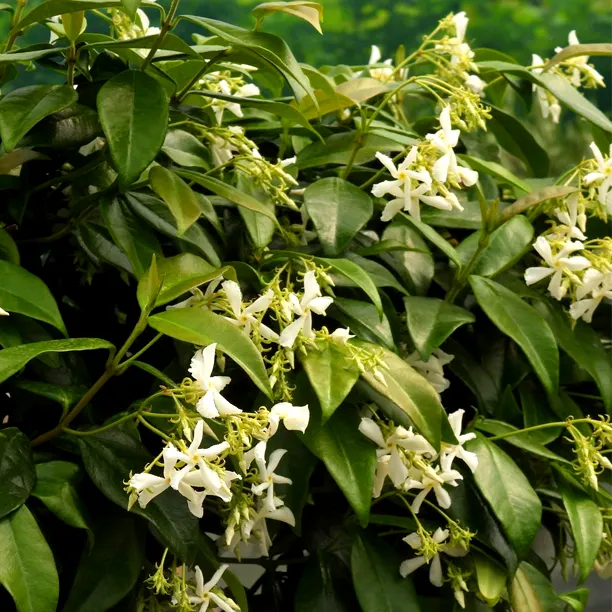
Star jasmine (Trachelospermum jasminoides) has become increasingly popular as our climate has warmed, offering glossy evergreen foliage and intensely fragrant white flowers in summer. It’s more cold-hardy than once thought, surviving temperatures down to -15°C when established.
This twining climber grows more slowly than clematis but provides incredibly dense coverage. The leaves often take on bronze-purple tints in winter, adding seasonal interest. Summer flowers appear from July onwards with an intoxicating scent that carries well on evening air.
Star jasmine excels on warm, sheltered walls and is particularly effective around seating areas where the evening fragrance can be appreciated. It requires minimal pruning and rarely suffers from pest problems.
| Feature | Star Jasmine Performance |
|---|---|
| Hardiness | -15°C when established, needs shelter when young |
| Fragrance period | July-September, strongest in evening |
| Coverage density | Very dense, excellent for screening |
| Growth speed | Moderate, 30-60cm per year |
| Maintenance | Very low, occasional thinning only |
Our star jasmine plants are container-grown for reliable establishment and come from proven hardy stock.
Which ivy varieties provide the best evergreen coverage?
Ivy remains unmatched for dense evergreen coverage in challenging conditions, particularly shade and exposed sites. Common ivy (Hedera helix) is virtually indestructible once established, while large-leaved varieties like Hedera colchica offer bolder foliage effects.
For decorative purposes, variegated forms like ‘Glacier’ or ‘Goldheart’ provide year-round colour interest. Self-clinging ivy requires no support structure but can damage poor-quality masonry over time through root penetration.
| Ivy Type | Leaf Size | Best Use |
|---|---|---|
| Hedera helix (Common) | Small, 3-8cm | Dense coverage, difficult conditions |
| Hedera colchica | Large, 10-25cm | Bold architectural effect |
| Hedera hibernica (Irish) | Medium, 5-12cm | Fast coverage, exposed sites |
| Variegated cultivars | Variable | Decorative colour, lighter shade |
Choose from our range of ivy plants including both species forms and decorative cultivars for specific garden situations.
How fast does Henry’s honeysuckle grow?
Lonicera henryi (Henry’s honeysuckle) ranks among the fastest-growing evergreen climbers, capable of adding 2-4 metres per year once established. This vigorous twiner produces small yellow flowers followed by distinctive black berries, but it’s grown primarily for rapid screening.
Unlike fragrant honeysuckles, Henry’s honeysuckle focuses its energy on vegetative growth rather than showy flowers. The narrow, dark green leaves create dense coverage year-round, making it ideal for quickly covering large fences or unsightly buildings.
This species tolerates more shade than most flowering climbers and isn’t particular about soil type. However, its vigour requires regular pruning to prevent it overwhelming nearby plants or growing beyond allocated space.
| Growth Aspect | Henry’s Honeysuckle |
|---|---|
| Annual growth | 2-4 metres per year when established |
| Ultimate height | 8-12 metres if unchecked |
| Flowering | Small yellow flowers, June-July |
| Shade tolerance | Good, better than most flowering climbers |
| Pruning needs | Annual pruning essential to control growth |
Our Henry’s honeysuckle plants are ideal for rapid screening projects where speed matters more than ornamental flowers.
When does Clematis cirrhosa flower?
Clematis cirrhosa provides unique winter interest, flowering from November through to February when most gardens are dormant. The nodding, bell-shaped flowers range from cream to pale yellow, often with attractive maroon spotting inside.
This Mediterranean species keeps its ferny evergreen foliage through mild winters but may become semi-evergreen in harsh conditions. It requires excellent drainage and benefits from protection from the wettest winter weather, making it perfect for a sheltered courtyard or conservatory wall.
The winter flowering habit makes Clematis cirrhosa particularly valuable, as it provides colour when little else is performing. However, flowers can be damaged by severe frost, so choose the most sheltered spot available.
Which evergreen climbers work best in shade?
Shade-tolerant evergreen climbers are essential for north-facing walls and areas under tree canopies. Ivy species top the list for deep shade tolerance, followed by Henry’s honeysuckle and certain Clematis species.
In moderate shade, star jasmine will grow well but may flower less prolifically than in sunny positions. Clematis armandii requires some direct sunlight to flower well but tolerates dappled shade for part of the day.
| Shade Level | Suitable Climbers | Performance Notes |
|---|---|---|
| Deep shade | Ivy species, Virginia creeper | Good foliage, minimal flowering |
| Moderate shade | Henry’s honeysuckle, Hydrangea petiolaris | Good growth, some flowering |
| Dappled shade | Star jasmine, Clematis montana | Good flowering if adequate light |
| Light shade | Clematis armandii, most evergreens | Near-optimal performance |
When should you plant evergreen climbers?
Plant evergreen climbers in autumn (September-November) or late spring (April-May) to avoid transplanting stress during their active growing period. Container-grown plants can be planted year-round if kept well-watered, but avoid periods of extreme weather.
Prepare planting areas by digging a hole twice the width of the root ball and incorporating plenty of organic matter. Most evergreen climbers prefer well-drained soil, so add coarse grit or perlite to heavy clay soils.
Install support structures before planting. Wire systems work well for twiners like star jasmine, while ivy and Clematis armandii can use trellis or wire mesh. Plant at least 45cm away from walls to ensure adequate root space and moisture access.
How do you maintain evergreen climbers?
Evergreen climbers require less intensive maintenance than deciduous species but benefit from annual attention. Most need pruning immediately after flowering to maintain shape and prevent excessive growth.
Water newly planted climbers regularly during their first two years. Once established, most evergreen climbers are reasonably drought-tolerant except during extended dry periods. Mulch annually with organic matter to conserve moisture and suppress weeds.
Watch for signs of stress during harsh winters, particularly on newly planted specimens. Provide temporary windbreak protection with horticultural fleece during extreme cold snaps.
| Maintenance Task | Frequency | Best Timing |
|---|---|---|
| Pruning | Annual | After flowering, late spring |
| Feeding | Annual | Early spring, balanced fertiliser |
| Mulching | Annual | Autumn or early spring |
| Support checking | Bi-annual | Spring and autumn |
Frequently Asked Questions
Are evergreen climbers suitable for covering fences?
Yes, evergreen climbers excel at fence coverage, providing year-round screening and privacy. Choose fast-growers like Henry’s honeysuckle for quick results.
How long do evergreen climbers take to establish?
Most establish within 2-3 years, with ivy and honeysuckle fastest. Star jasmine and Clematis armandii may take longer initially but accelerate once settled.
Do evergreen climbers damage walls?
Self-clinging types like ivy can damage weak mortar over time. Use wire support systems for valuable buildings and check wall condition regularly.
Can evergreen climbers grow in containers?
Yes, though they’ll need large containers (minimum 60cm diameter) and regular watering. Try Clematis armandii or compact ivy varieties for pots.
Which evergreen climbers attract wildlife?
Ivy provides excellent winter cover and autumn berries for birds. Henry’s honeysuckle berries also attract birds, while flowering species benefit pollinators.
How fast do evergreen climbers grow?
Growth rates vary significantly: ivy grows 1-2m annually, Henry’s honeysuckle up to 4m, while star jasmine manages 30-60cm per year.
Do evergreen climbers need support structures?
Most require support except self-clinging ivy. Wire systems, trellis, or mesh work well depending on the climbing method of each species.
Can you grow evergreen climbers from cuttings?
Many root easily from semi-hardwood cuttings taken in summer. Ivy roots particularly readily, while clematis species can be more challenging.
Which evergreen climbers are most cold-hardy?
Ivy species are virtually indestructible in UK conditions. Henry’s honeysuckle and established star jasmine also handle cold well.
Do evergreen climbers flower every year?
Most flower annually once mature. Clematis armandii and star jasmine are reliable bloomers, while ivy flowers only after many years of growth.
How do you prevent evergreen climbers becoming too vigorous?
Annual pruning after flowering controls growth effectively. Root barriers can also limit spread for particularly vigorous species like ivy or Henry’s honeysuckle.
Are there scented evergreen climbers?
Yes, Clematis armandii offers vanilla fragrance in spring, while star jasmine provides intense evening scent through summer months.
Related Products
- Clematis collection – evergreen and deciduous varieties
- Climbing plants – comprehensive range for all situations
- Screening plants – fast-growing privacy solutions
- Fragrant plants – scented climbers and shrubs
Related Articles
- Complete clematis growing guide
- Fast-growing plants for privacy screening
- Wall shrubs for challenging situations
- Scented climbers for garden fragrance
Related guides
- Best climbing plants — which climber for walls, fences, scent, shade and screening
- Clematis pruning groups explained — Groups 1, 2 and 3 with variety lists
- Clematis wilt — what it is, how to prevent it, and which varieties resist it
- Do climbing plants damage walls and fences?
- How deep do I plant a clematis?
Leave a Reply