
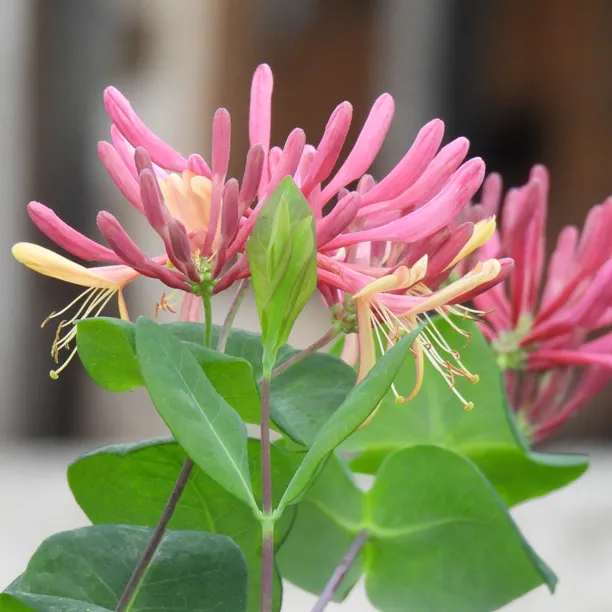
How to grow honeysuckle successfully in your garden?
Honeysuckle is one of Britain’s most beloved climbing plants, prized for its intoxicating evening fragrance and ability to transform bare walls, fences and pergolas into scented havens. These versatile climbers thrive in most UK gardens with minimal care once established, rewarding gardeners with months of tubular flowers that attract moths, bees and hummingbird hawk-moths.
Whether you choose evergreen varieties for year-round structure or deciduous types for spectacular autumn colour, honeysuckle offers something for every garden situation from full sun to partial shade.
Related articles
- Best climbing plants for UK gardens
- Creating a fragrant garden
- Plants that attract wildlife
- Evergreen climbers for year-round interest
Which honeysuckle varieties are best for UK gardens?
The most popular honeysuckles for British gardens include highly fragrant varieties like Lonicera periclymenum ‘Belgica’ and evergreen options such as Lonicera henryi. Each type offers distinct advantages depending on your garden’s conditions and your preferences for scent, flowering time, and foliage retention.
Native British honeysuckle (Lonicera periclymenum) and its cultivars remain the top choice for wildlife gardens, producing the strongest evening fragrance and supporting native moths whose caterpillars feed exclusively on these plants. Japanese honeysuckle (Lonicera japonica) varieties offer evergreen foliage but can become invasive in mild areas.
| Variety | Type | Fragrance | Flowering | Height |
|---|---|---|---|---|
| L. periclymenum ‘Belgica’ | Deciduous | Very strong | May-June, Sept | 4-6m |
| L. periclymenum ‘Serotina’ | Deciduous | Very strong | July-October | 4-6m |
| L. henryi | Evergreen | Mild | June-August | 6-8m |
| L. japonica ‘Halliana’ | Semi-evergreen | Strong | June-October | 8-10m |
When should you plant honeysuckle?
Plant container-grown honeysuckle any time from March to November when the soil isn’t frozen or waterlogged. October and November planting allows roots to establish during winter, resulting in stronger growth the following spring.
Avoid planting during hot summer periods unless you can provide consistent watering, as honeysuckle establishes best in cool, moist conditions. Bare-root plants should only be planted between November and March while dormant.
What soil conditions do honeysuckles prefer?
Honeysuckles thrive in fertile, well-drained soil that retains moisture but never becomes waterlogged. They prefer neutral to slightly alkaline soil (pH 6.5-7.5) but tolerate most garden soils including heavy clay if drainage is adequate.
Improve poor soils by digging in plenty of well-rotted compost or manure before planting. In chalky soils, add organic matter annually to maintain moisture retention and prevent the iron deficiency that causes yellowing leaves.
| Soil Type | Suitability | Preparation Needed | Best Varieties |
|---|---|---|---|
| Clay | Good if well-drained | Add grit and organic matter | All varieties |
| Sandy | Excellent | Add compost for moisture retention | All varieties |
| Chalk | Good | Annual organic matter addition | Native species preferred |
| Waterlogged | Poor | Install drainage or raise beds | Avoid planting |
How do you plant honeysuckle correctly?
Dig a planting hole twice the width of the root ball but only as deep as the container. Position the plant so the soil level matches the existing compost level on the stem, never burying the stem deeper than it was originally growing.
Space plants 1.5-2 metres apart if planting multiple honeysuckles. Water thoroughly after planting and apply a 5cm mulch of compost or bark chips, keeping mulch 10cm away from the stem base to prevent rot.
| Step | Action | Why Important |
|---|---|---|
| 1 | Soak root ball for 30 minutes | Ensures roots are fully hydrated |
| 2 | Dig hole 2x width, same depth | Allows roots to spread easily |
| 3 | Mix excavated soil with compost | Improves soil structure and nutrition |
| 4 | Plant at same depth as container | Prevents stem rot and establishment problems |
| 5 | Water thoroughly and mulch | Eliminates air pockets, conserves moisture |
Do honeysuckles need sun or shade?
Most honeysuckles perform best with their roots in cool, shaded soil and their growing tips in sun or light shade. This mimics their natural woodland edge habitat where they climb through shrubs to reach light.
While they tolerate full shade, flowering is reduced and fragrance may be weaker. In very hot, sunny positions, ensure the root zone stays cool and moist with thick mulching and regular watering during dry spells.
How do you train honeysuckle on supports?
Honeysuckles are twining climbers that need horizontal wires, trellis, or other plants to twist around. They cannot grip smooth vertical surfaces like walls without support structures, unlike self-clinging climbers such as ivy.
Install horizontal wires 30-45cm apart, or provide trellis panels with openings no larger than 15cm square. Guide young shoots to supports by gently wrapping them around wires – they’ll quickly learn to climb independently. For pergolas and arches, allow stems to spiral naturally around uprights.
| Support Type | Best For | Installation | Maintenance |
|---|---|---|---|
| Horizontal wires | Walls and fences | 30cm spacing, 5cm from wall | Check tension annually |
| Wooden trellis | Decorative screening | 15cm squares maximum | Treat wood every 3-5 years |
| Metal arches | Garden features | Minimum 2.5m height | Minimal – check fixings |
| Living supports | Naturalistic gardens | Plant through shrubs/trees | Prune both plants carefully |
How often should you water and feed honeysuckle?
Established honeysuckles need supplementary watering only during prolonged dry spells, but keep the root zone consistently moist during the first growing season after planting. Deep weekly watering is more beneficial than frequent shallow watering.
Feed annually in early spring with a balanced fertiliser or well-rotted compost mulch. Avoid high-nitrogen feeds which promote excessive leafy growth at the expense of flowers. A potash-rich feed in late summer can improve flowering the following year.
When and how should you prune honeysuckle?
Pruning requirements depend on the variety and flowering time. Early-flowering honeysuckles like ‘Belgica’ bloom on previous year’s wood and should be pruned immediately after flowering in July. Late-flowering varieties like ‘Serotina’ can be pruned in late winter or early spring.
Young plants need minimal pruning beyond removing dead or damaged growth. Established plants benefit from annual thinning to prevent the tangled mass of stems that can develop. Remove about one-third of the oldest stems at ground level to encourage fresh growth from the base.
| Variety Type | Flowering Time | Pruning Time | Method |
|---|---|---|---|
| Early (L. periclymenum ‘Belgica’) | May-June | July after flowering | Light trim, remove old stems |
| Late (L. periclymenum ‘Serotina’) | July-October | February-March | Remove 1/3 of oldest growth |
| Evergreen (L. henryi) | June-August | March | Minimal – shape only |
| Japanese (L. japonica) | June-October | March | Hard prune to control spread |
Why doesn’t my honeysuckle smell and when is fragrance strongest?
Honeysuckle fragrance is strongest in the evening when the flowers open fully to attract night-flying moths. Some varieties are virtually scentless during the day but become intensely fragrant from dusk onwards, particularly on warm, still evenings.
Young plants may take 2-3 years to develop full fragrance intensity. Plants grown in heavy shade often produce fewer flowers and weaker scent. If your established honeysuckle lacks fragrance, check it’s a scented variety – some modern hybrids sacrifice scent for extended flowering or disease resistance.
What are the most common problems with honeysuckle?
Aphid infestations are the most frequent issue, causing sticky honeydew deposits and sooty mould on leaves. Treat with insecticidal soap or encourage natural predators like ladybirds and lacewings by providing diverse garden plantings.
Powdery mildew often affects plants in dry conditions or poor air circulation. Ensure adequate spacing between plants, avoid overhead watering, and remove affected leaves promptly. Yellowing leaves usually indicate waterlogging or, in chalky soils, iron deficiency requiring annual organic matter addition.
Frequently Asked Questions
How fast does honeysuckle grow?
Most honeysuckles grow 1-2 metres per year once established, reaching mature height within 3-5 years. Japanese varieties can grow even faster but may become invasive without regular pruning.
Can honeysuckle damage walls or structures?
Honeysuckle won’t damage sound masonry but can exploit existing cracks. The stems can become heavy over time, so ensure support structures are robust enough for the mature plant’s weight.
Is honeysuckle evergreen or deciduous?
This depends on the variety. Native British honeysuckle is deciduous, while Lonicera henryi is evergreen. Some Japanese varieties like ‘Halliana’ are semi-evergreen in mild areas.
When do honeysuckles flower?
Flowering time varies by variety. Early types like ‘Belgica’ flower May-June, while late varieties such as ‘Serotina’ bloom July-October, providing extended interest.
Do honeysuckles attract wildlife?
Yes, native honeysuckles are excellent for wildlife, supporting specialist moths whose caterpillars feed only on these plants. The flowers attract night-flying moths, bees, and hummingbird hawk-moths.
Can you grow honeysuckle in containers?
Honeysuckles can grow in large containers (minimum 60cm diameter) but need consistent watering and annual feeding. Choose compact varieties and provide strong support structures for the climbing stems.
Why are my honeysuckle leaves turning yellow?
Yellow leaves usually indicate waterlogging, drought stress, or nutrient deficiency. Check soil drainage and moisture levels, then feed with balanced fertiliser if the plant appears undernourished.
How do you propagate honeysuckle?
Take semi-hardwood cuttings in late summer or layer flexible stems in spring by pegging them to soil while still attached. Both methods have good success rates for home propagation.
Can honeysuckle grow in full shade?
Honeysuckles tolerate partial shade but flowering and fragrance decrease in deep shade. They perform best with morning sun and afternoon shade, or dappled light throughout the day.
How long do honeysuckle plants live?
Well-maintained honeysuckles can live for decades. Native varieties are particularly long-lived, often surviving 20-30 years or more with appropriate care and periodic rejuvenation pruning.
Should you deadhead honeysuckle flowers?
Deadheading isn’t necessary but can prolong flowering in some varieties. Leave flowers on wildlife-friendly plants as the berries provide food for birds through autumn and winter.
Can honeysuckle be grown as ground cover?
Without vertical support, honeysuckle will sprawl as ground cover, though it’s less effective than purpose-bred ground cover plants. This works well on banks or naturalistic areas where it can scramble freely.
Related Products
- Honeysuckle Collection – All Varieties
- Climbing Plants for Gardens
- Fragrant Garden Plants
- Wildlife-Friendly Plants
Related Articles
- Best climbing plants for UK gardens
- Creating a fragrant garden
- Complete wildlife gardening guide
- How to train climbing plants
Related guides
- Best climbing plants — which climber for walls, fences, scent, shade and screening
- Clematis pruning groups explained — Groups 1, 2 and 3 with variety lists
- Clematis wilt — what it is, how to prevent it, and which varieties resist it
- Do climbing plants damage walls and fences?
- Evergreen climbing plants — year-round cover for walls, fences and screens
Leave a Reply