
Planting bulbs under trees and hedges turns the barest patch of the garden into the first flowers of the year. Here’s which bulbs cope with shade and roots, and how to plant them.
Beside the lake, beneath the trees
On 15 April 1802, Dorothy Wordsworth and her brother William were walking the shore of Ullswater when they came upon daffodils in the woods by the water. There were more than she had ever seen: some resting their heads on the mossy stones, the rest tossing about in the wind coming off the lake. She wrote it up in her journal. Two years later William borrowed the entry for a poem you very likely had to learn at school, the one that begins “I wandered lonely as a cloud”.
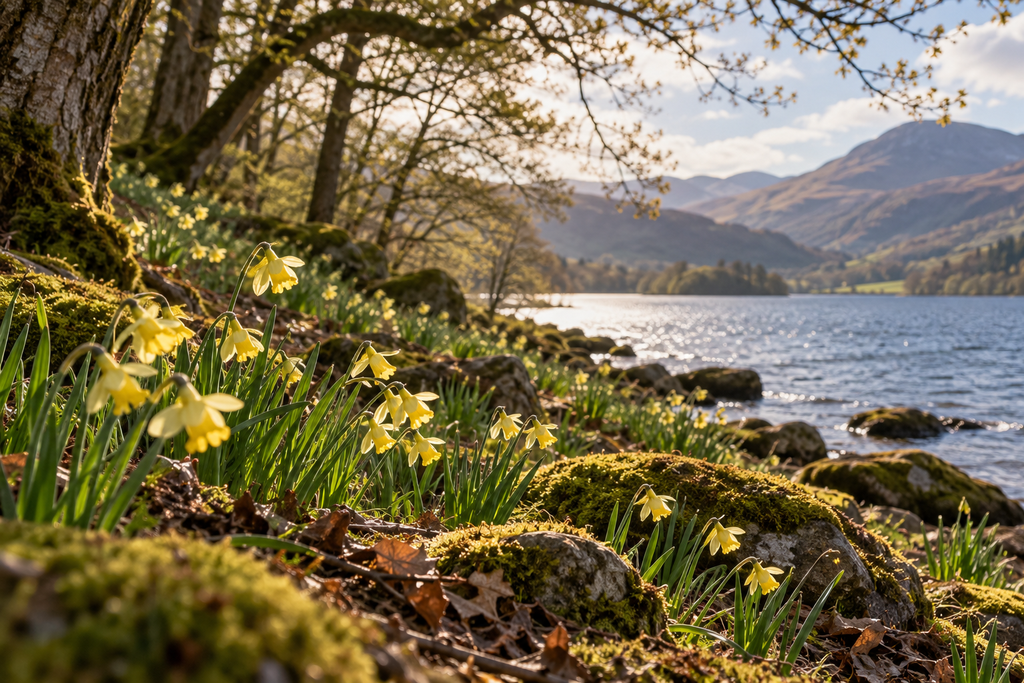
What they found was not a bed of daffodils. These were wild ones, Narcissus pseudonarcissus, small and pale-petalled, growing in the thin spring light under trees, in ground no gardener had ever touched.
Which brings us to the dullest patch in your garden. The strip along the bottom of the hedge, the dusty circle under the birch: bare soil, a few weeds, last autumn’s leaves. It is exactly where snowdrops, aconites, cyclamen and bluebells grow wild in Britain, and exactly where they do best in a garden. Plant them there this autumn and that strip of nothing gives you the first flowers of the year, from January until the leaves close over in May. Once settled, they spread on their own and ask almost nothing of you.

Why bulbs thrive under deciduous trees
Woodland bulbs keep a different calendar from the rest of the garden. They do all their growing while the branches overhead are bare, from January to April, with full light and the whole of the winter rain to themselves. By the time the tree comes into leaf they have flowered, fed next year’s bulb and are heading for bed. The dry summer shade that would finish off most border plants suits a resting bulb perfectly.
So it works under anything that drops its leaves: birch, cherry, crab apple, hawthorn, field maple, oak and fruit trees. The lighter the canopy, the wider your choice.
Three places are harder going:
- Under evergreens. Yew, conifers, holly and laurel shade the ground all year and keep it bone dry. Only cyclamen will put up with it, and only at the edges.
- Hard against the trunk. The soil there is a mat of roots and the canopy sheds most of the rain. Start at least 30cm (1ft) out.
- Under beech and horse chestnut. Both leaf out early, cast dense shade and root near the surface. Snowdrops, aconites and cyclamen cope; daffodils and bluebells struggle.
The best bulbs to plant under trees

For deep shade, start with snowdrops, aconites and cyclamen; they are the toughest of the lot. In the dappled shade of a birch or an apple tree, almost anything below will do. The one bulb to leave out is the tulip, which wants sun and a summer baking and will dwindle away in the shade.
| Bulb | Flowers | Best for |
|---|---|---|
| Cyclamen coum | January–March | The driest, darkest spots, even close to the trunk |
| Snowdrops | January–March | Deep shade under trees and along hedge bottoms |
| Winter aconites | January–March | Under trees, where they seed into a yellow carpet |
| Anemone blanda | February–April | Light shade under small trees |
| Siberian squill | March–April | Light shade; an intense blue that spreads freely |
| Wild daffodils | March–April | Under deciduous trees and along hedges |
| Wood anemones | March–April | Leafy soil under trees and native hedges |
| English bluebells | April–May | Native hedges, and under oak, hazel or birch |
| Ivy-leaved cyclamen | September–November | Dry shade; autumn flowers, then marbled leaves all winter |
The wild daffodil is the one the Wordsworths saw, and it earns its place. Smaller and more graceful than the garden kinds, it looks as though it arrived on its own, which under a tree is the whole point.
Snowdrops, curiously, may not be native at all. They were not recorded growing wild in Britain until the late 18th century, and most of the great drifts you see in February started in old churchyards and rectory gardens. Nobody minds; they have made themselves thoroughly at home.
Bluebells are another matter. Britain holds something like half the world’s population of the native English bluebell, so near a native hedge or a woodland edge plant English bluebells and never the Spanish kind. Spanish bluebells are coarser, and they cross with the native ones, slowly diluting them.
If you would rather not choose, the Mixed Woodland Bulb Collection brings together bluebells, snowdrops, wild daffodils and wood anemones for flowers from February to May.
How to plant bulbs under trees, among the roots
You cannot dig a trench under a tree, and you shouldn’t try. Bulbs go in one at a time, in the gaps between the roots.
- Scatter, then plant where they land. Toss a handful gently across the ground and plant each bulb where it falls. That is how you get a wood rather than a roundabout: loose drifts, not rows or a tidy ring around the trunk.
- Use a narrow trowel or a long-handled bulb planter. Push in and waggle. If you hit a root, move a few centimetres along. Never cut a root thicker than your finger.
- Plant at two to three times the bulb’s height. That is about 8cm (3in) for snowdrops and squill, 15cm (6in) for daffodils. Cyclamen are the exception: set the corms just below the surface, hollow side up.
- Backfill with leaf mould or garden compost if the soil is thin or dusty. Don’t pile extra soil round the trunk to give yourself depth; trees resent having their roots buried.
- Water them in if the ground is dry, which under trees in autumn it usually is.
Along a hedge, plant on the sunnier side, 30–45cm (12–18in) out from the stems, where some rain reaches the soil. And plant in groups of at least 10–20 of one kind. A few dotted about singly get lost; a generous handful looks as if it has always been there.
Planting a new tree or hedge this winter?
Think about the bulbs now, even if the tree won’t reach you until December. Dry bulbs need to be in the ground by the end of November, while bare-root trees and hedging (dug from the field while dormant, no pot, no compost) go in from November to March. The two rarely arrive together, so you have a choice.
Plant the bulbs first. Put dry bulbs in this autumn where the tree or hedge will go: around the spot for the tree, well clear of where its planting hole will be, or in a strip 30–45cm (12–18in) in front of the line of the new hedge. Mark the area with canes, or somebody will dig them up in January.
Or plant them in the green. Wait, and plant snowdrops, bluebells and daffodils with their leaves on in February and March, alongside the last of the bare-root season. Either way, you can add more dry bulbs around the young tree or hedge next autumn.
Two things to bear in mind. A young tree wants a 1m (3ft) circle free of grass and weeds for its first two or three years; small bulbs at the edge of that circle do little harm, since they are dormant by the time the tree needs its summer water. And hedge bulbs go along the front, not in the row, so they don’t compete with the young whips and you can still reach them.
A native hedge of hawthorn, hazel and field maple with bluebells, wild daffodils and wood anemones at its foot is about as close to a piece of English countryside as a garden gets. Our native hedging and native trees are the other half of the picture.
Caring for bulbs under trees and hedges
Very little is needed, and most of it is restraint. Leave the fallen leaves where they lie each autumn. They rot down into exactly the leafy soil woodland bulbs like, and snowdrops will push straight through them.
The one rule is to let the foliage die down on its own. Don’t strim, mow or tidy the hedge bottom for about six weeks after flowering, because those leaves are feeding next year’s flowers. If you cut your hedge in late summer, as most people do, the bulbs will be long asleep by then.
Give them a few years and snowdrops, aconites, cyclamen and squill will seed themselves about and fill the gaps for you. The Wordsworths’ daffodils had been at it for centuries; yours have only to start.
Questions people ask
Will bulbs harm my tree or hedge? No. They are small, shallow-rooted and dormant all summer, just when trees and hedges need water most.
Can I plant bulbs under a conifer hedge? Only cyclamen, and only along the outer edge where some rain gets in. Under the hedge itself is too dark and too dry for anything.
Should I buy snowdrops dry or in the green? Either works. Dry bulbs are cheaper and go in now; snowdrops in the green, planted in February or March, tend to settle faster. Dry snowdrops dislike sitting about, so plant them the day they arrive.
How many bulbs do I need? For a natural look under a tree, allow around 50 small bulbs (snowdrops, crocus, squill) or 25 daffodils per square metre. Plant more in the first year if you can; they will spread from there.
Bulbs, trees and hedging
- Mixed Woodland Bulb Collection
- Native English bluebells, snowdrops, cyclamen and daffodils
- Bulbs in the green, delivered February to March
- Birch trees, whose light canopy suits bulbs best
- Hedging plants, native and for shade
- How deep to plant flower bulbs

Leave a Reply